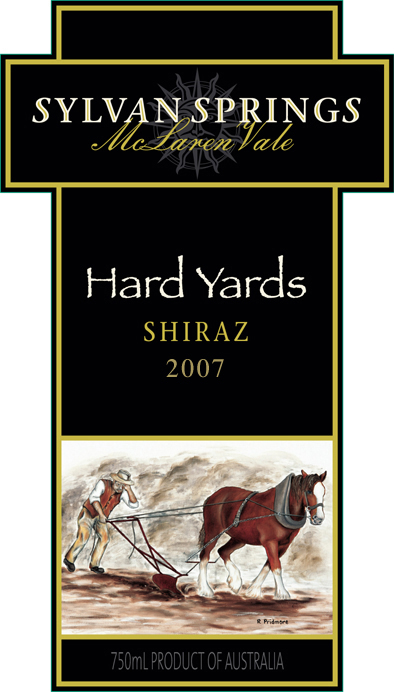
Sylvan Springs Hard Yards Shiraz 2007 McLaren Vale

000233_Hard_Yards_Shiraz_05.aiProducer: Sylvan Springs

Grapes: Shiraz (presumably 100%, but it doesn’t say so on the tech sheet)

Appellation: McLaren Vale (Australia)

Vineyard: Soils are “grey sand over ironstone gravel layer over orange permeable clay.” At least some of the fruit comes from the Blewitt Springs sub-region.

Winemaking: No new oak – the wine spent 12 months in a mix of 2-4 year old French and American oak barrels.

Alcohol: 14.6%

Price: I paid around $12 or $13 at Costco. I found the receipt: $10.99

My tasting notes: Big, wild, brambly fruit on the nose along with floral/violet and cedar notes. It’s a bit “fumey” from the alcohol. On the palate, it’s dense and weighty, hitting you with smooth-textured, mouth-filling blackberry and black currant flavors with an herbal edge. Despite the extracted fruit, it manages to feel tense, muscular – I even wrote down lean, though that’s often used to indicate lack of fruit, which isn’t the case here. There’s a very nice minerality as well and it finishes with a pleasant little sharpness or bitterness.

Overall impression: This is striking the right chord for me tonight. Give me expressive fruit, but balanced with minerality and acid, and I’m a happy wino. B+

Free association:
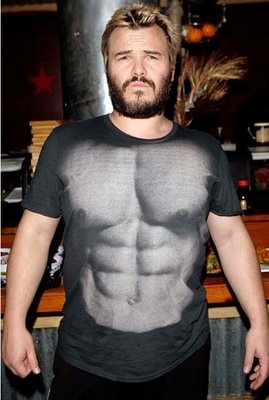
JackBlack_abs

More info:

2000 cases produced.

This wine was scored 90 points by Jay Miller in Robert Parker’s The Wine Advocate.
A Trumpet Blast

Here’s an interesting post from Randall Grahm on the Been Doon So Long blog titled “Chick Vit or What Do Women Want (in their Wine)”. While the post starts out with the question of whether his wines might appeal more to women than men, Randall covers lots of interesting ground (as usual). Worth a full read, but my favorite bit is this:

Maybe in some of my wines the standard signifiers of “quality,” if not missing, are at least perhaps a bit occluded.12 What actually is “quality” in a New World wine? I think that one would be hard pressed to insist that it is authenticity or trueness to its Platonic essence, because likely there is no such Platonic essence, especially if the wine does not come from a singular vineyard, and that vineyard is not farmed in such a way to optimally express its unique character. I believe that all of us hold some sort of template in our brains as far as what constitutes “quality” and what provokes our interest in a particular wine; likely we respond to wine in ways analogous to other sensual stimuli. Perhaps wine affects us a bit like music does, though its balance and logic does not have the same kind of temporal sequencing. With wine the elements are initially apprehended all at once in a sort of trumpet blast and then slowly, almost imperceptibly they shape-shift and unfold with time. Most people, at least us Westerners, are attuned to tonal music, with a recognizable structure and a predictable, inevitable logic; there is satisfaction and resolution when the melody returns to the tonic, a harmonic resonance of a few key elements. In wine maybe these elements are wood, fruit, tannin and minerals (though nobody really knows what this last category really means). Withal, I would suggest that these flavor elements cannot simply be present but they need to be organized in such a way that suggests that they represent something. Put another way, in a vin de terroir, the unique qualities of the site are driving the bus, in a vin d’effort, a winemaker with a strong stylistic vision is driving the bus. But somebody’s driving.

By the way, it you’re not following him on Twitter, fix that.

Does This Wine Still Make Me “Smiley”?

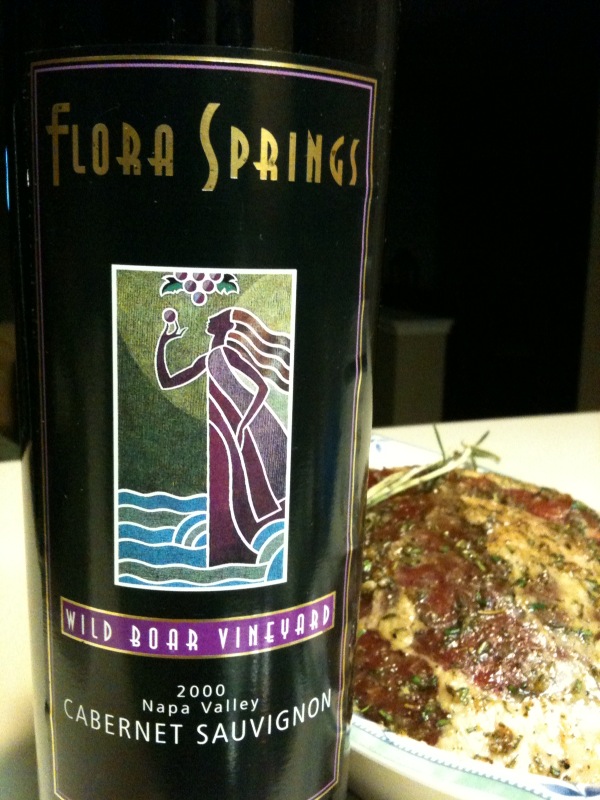
florasprings_cab_2000_snapshotI bought this wine on a trip to Napa/Sonoma about 5 years ago. It was my favorite wine of the trip and I splurged the $85 in the tasting room to bring home a bottle. Now if you’ve ever been on a wine country trip, I’m sure you’re familiar with the phenomenon whereby your capacity for objective evaluation and cost/benefit analysis diminishes as the day wears on. Well, Flora Springs was the 5th stop that day and I had not done enough spitting. So in my notes on this wine I wrote: “Smiley!” As in, this wine makes me feel smiley. See, I told you I should have done more spitting.

Anyhow, I’ve been holding on to this wine for a special occasion, but I never seem to find one, so I decided just to uncork it tonight with my grilled leg of lamb. Let’s check it out. Does it still make me smiley?

Flora Springs Wild Boar Vineyard Cabernet Sauvignon 2000 Napa Valley

Producer: Flora Springs

Grapes: 100% Cabernet Sauvignon

Appellation: Napa Valley (from the Pope Valley sub-region)

Matt Kramer, in his book New California Wine (published in 2004), picks on Pope Valley  saying “However much various Napa Valley powers … insist that Pope Valley really is a legitimate part of the Napa Valley appellation – which it legally is – the wines tell us differently.”

Vineyard: The grapes for this wine come from a hillside block of the winery’s Cypress Ranch Vineyard, which reaches 1200 feet.

Winemaking: The wine spent 30 months in barrel, mostly French.

Alcohol: 14.4%

Price: I paid about $85 at the winery about 5-6 years ago.

My tasting notes: The color of this wine is still inky dark, showing no real signs of age yet. The nose is rich and bold, with dark, blackberry fruit and notes of chocolate/cocoa and cedar. The flavors are similarly rich, with cherries and more blackberries, along with spice and sweet tobacco notes. It feels polished in the mouth; not a lot of tannin here. I’m wanting a little more structure. It has a lengthy finish.

Overall impression: It’s good. I’m enjoying it. If you get a chance to drink it, go for it. But after 85 bucks and 5 years taking up a slot in my cellar, I’m not feeling quite as smiley as I did that buzzy afternoon 5 years ago. B

Free association:

smileyface_smirking

Image credit: SuanSKatra

More info:

Even though this bottle didn’t live up to my memory of it, if you’re in Napa and hitting the wineries on the main drag, Flora Springs is a good stop. I liked just about every wine they were pouring, including a Sangiovese.

330 cases of the wine were produced.

I can’t find any other reviews of this wine online.

The Year of Mourvèdre

At the beginning of a new year, I have usually tried to pick a focus for my wine drinking in the upcoming year. This year I considered a number of regions that have been intriguing me:

  • Portugal
  • Montsant (Spain)
  • Northern Italy
  • Washington

I’m sure I’ll be seeking out stuff from these regions this year, but in the end I’ve decided to make Mourvèdre my focus. I’ve been a fan of this grape for a long time and I recently noticed that almost every wine I reviewed on my blog that included Mourvèdre in the blend was a winner. Picking a grape instead of a region will also allow me to include wines from lots of places I love: the Southern Rhône, the old-vines stuff in California, the GSMs of Australia, the Monastrell in Spain. Plus, Bandol and other parts of Provence – areas I’ve not had much experience with.

Now this doesn’t mean VINEgeek will be all Mourvèdre, all the time in 2010. My plan is to start Mourvèdre Mondays in the next couple of weeks. With weekly posts, I’ll make it through 50 or so Mourvèdre wines over the course of the year. That ought to help me get to know this grape better. I hope you’ll join me.

If you have a favorite Mourvèdre-based wine you’d like to see me try, leave a comment.

Wineries: If you have a Mourvèdre-based wine you’d like me to include in Mourvèdre Mondays, see the Sample Policy.