Mourvèdre Monday #24: Castaño Hecula 2005

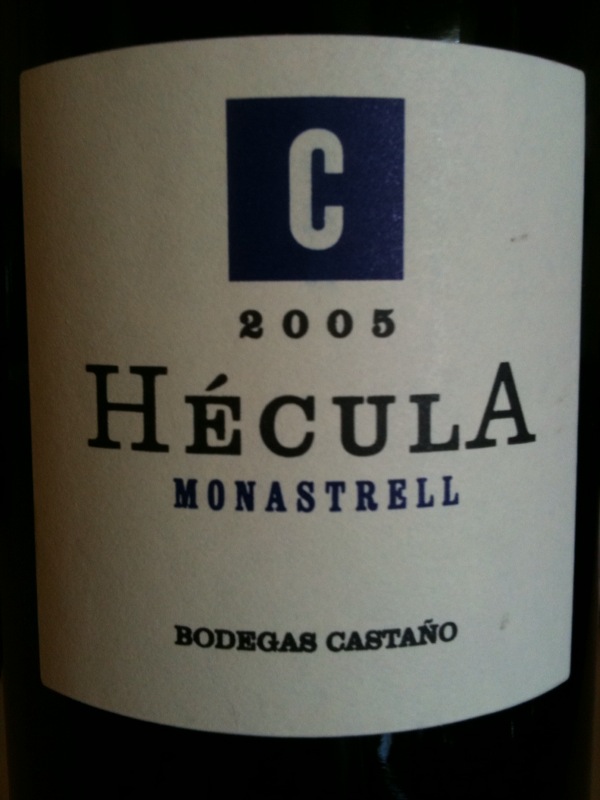
Back to Spain for Mourvèdre Monday. This one’s from Bodegas Castaño, one of the biggest producers of Monastrell in Yecla, in southeastern Spain. This wine got 90+ points from Parker for 5 straight vintages, including this one. Let’s see what’s up.

Producer: Bodegas Castaño

Grapes: 100% Monastrell

Appellation: Yecla

Vineyards: From 30+ year old vines in two vineyards: Las Gruesas and Pozuelo. Both with soils of sand, clay and limestone.

Vintage: 2005

Winemaking: 6 months of aging. It’s not clear from tech sheet in what vessel, but I would guess tank or neutral oak.

Alcohol: 14.5%

Price: Around $12

Tasting notes: Dusty fruit on the nose playing second fiddle to dried flowers and a sweaty, meaty aroma. I catch a fleeting licorice note as well. On the palate there are rich blackberry and red fruit flavors with an interesting mossy background note. Finishes short and dry with a little heat.

Overall impression: Some intriguing elements that don’t quite come together into a harmonious whole as well as I would like. Still an nice bottle that I enjoyed spending the evening with. And a nice value at around $12. B

Free association:

More info:

90 points from Parker and Tanzer. Parker gave this wine 90 or 91 points in vintages 2002-2006.

Jeff over at Viva La Wino reviewed this one last year and loved it.

Mourvèdre Monday #23: Becker Vineyards Prairie Rotie 2007

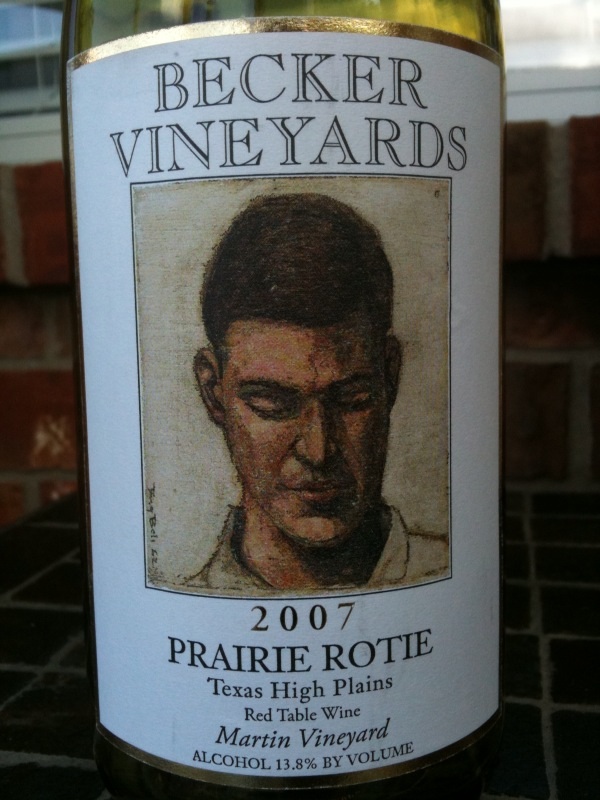
Mourvèdre Monday finally makes it to Texas. Becker is a big name in the Texas wine scene. I’ve tried quite a few of their wines over the years with mixed results. I had high hopes for their “Prairie Rotie” — a Southern Rhône blend of Mourvèdre, Grenache, Syrah and Carignan (though the name is a play on Côte Rôtie, which is a Northern Rhône appellation where the wines are either all Syrah or Syrah + Viognier). Let’s check it out.

Producer: Becker Vineyards,whose winery and tasting room are in the Texas Hill Country near Fredericksburg

Grapes: 68% Mourvèdre, 14% Grenache, 12% Syrah, 6% Carignan

Appellation: Texas High Plains AVA – way up in the panhandle

Vineyard: Martin Vineyard

Vintage: 2007

Winemaking: This wine spent 9 months in new American oak barrels.

Alcohol: 13.8%

Price: $16.95 on Becker’s website, but I believe I paid about a few dollars less at HEB (supermarket).

Tasting notes: This wine smells purple, grapey. Or like some imaginary Kool-aid flavor called Sparkleberry. Some sweet oak coming through pretty strong as well. Extracted, overripe berry fruit on the palate, coming across a little raw. The winery’s description promisingly mentions forest floor and herbs and coffee, but I didn’t pick up any of that in the wine. I grew bored of this very quickly.

Overall impression: A Texas winery taking pains to make and market this as a Rhône-style wine set my expectations to a way different place. I hope Becker (and others) continue working with these grapes here in Texas, but this particular wine didn’t do much for me. C

Free association:

Oddball Wine of the Week: Niellucciu

When I saw “Niellucciu” named as the grape on the back label — which looks to me more like a Scrabble rack than any grape variety I’d ever hear of — I bought first and asked questions later. Back home, Oz Clarke’s Grapes and Wines — a must-own book in my opinion — revealed to me that Niellucciu is a Corsican grape that’s identical to Sangiovese. Well, okay, so not a new grape to me. But French Sangiovese and the unusual synonym qualifies it for Oddball Wine of the Week. Let’s check it out.

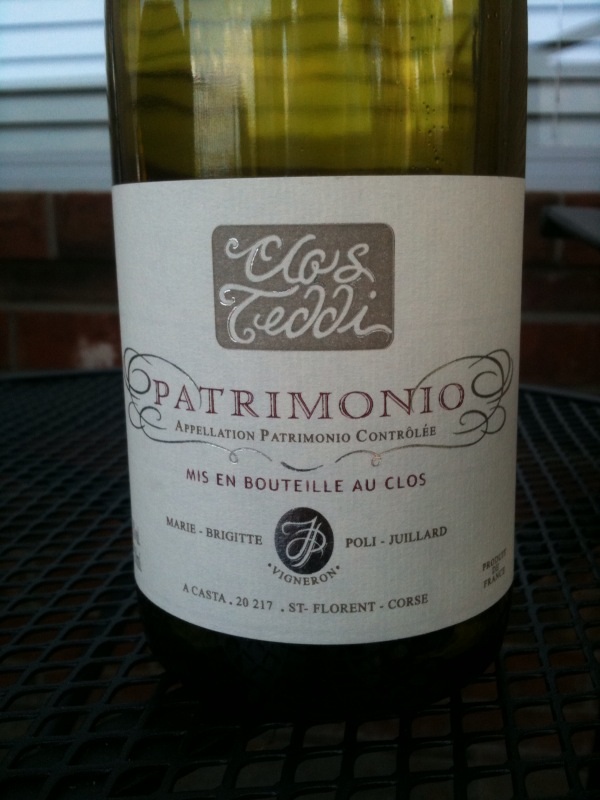
Clos Teddi 2006 Patrimonio

Producer: Clos Teddi

Grapes: 100% Niellucciu (Sangiovese) – hear it pronounced here

Appellation: Patrimonio (AOC, France) – the first AOC in Corsica

Vineyards: 25-35 year old vines in “granitique” sand in the Agriates desert. Farmed organically.

Vintage: 2006

Winemaking: 12 months in tank before bottling

Alcohol: 13%

Price: I paid $21.37 at Spec’s in Austin

Tasting notes: Starts with a stout Old World funk. Meaty. Savory. Sweaty. But with a very nice sweet strawberry note at the core. On the palate, it’s medium-bodied with more red fruit flavors and a tannic, plum skin note. Dry finish.

Overall impression: I enjoyed this quite a bit. That strawberry note on the nose really made this one for me. If you see it, give it a try. B

Free association:

Three Thoughts on the Latest Wine Spectator (Aug. 31, 2010)

It’s the “Best Restaurants for Wine Lovers” issue with a directory of all their award winners. I don’t want to rehash the legitimate questions about the level of scrutiny (or lack thereof) applied to these awards. I just want to take them at face value and make some observations.

1. Apparently, you can’t have a best-of-the-best wine programs without strength in Bordeaux. Of the 75 Grand Award winners around the world — the three glass ratings — only one doesn’t have Bordeaux (or France, generally) among the “wine strengths” listed in it’s profile. The sole exception to the rule is Del Posto, whose strengths are listed as Italy and Champagne.

More intriguing to me are the “Best of Award of Excellence” winners (what an awkward name) — the two glass ratings — that have a more interesting or unexpected emphasis:

  • Everest (Chicago): Alsace
  • Salpicón (Chicago): a “comtemporary Mexican” restaurant with strengths in California, Spain, Austria and Italy.
  • Lotus of Siam (Las Vegas): a Thai restaurant with strengths in Germany and France.
  • Hearth (NYC): wine strengths listed as “International” – I can imagine the editor reviewing their geeky-cool list, throwing his/her hands up in dismay and saying let’s just call it “International”
  • Telepan (NYC): wine strengths include the Loire, in addition to California, Italy and Burgundy.
  • Bleeding Heart (London): a contemporary French restaurant with strength in New Zealand wines (and French)
  • Deli Swiss (Dominican Republic): a “French/Caribbean” restaurant with wine strengths in Spain, France, Chile and Argentina

2. There are no two or three glass winners here in Austin, Texas. That means we’re trailing noted culinary hotspots like:

  • Pittsboro, NC (Fearrington House Restaurant)
  • Moose, WY (Dornan’s)
  • Iowa City, IA (Chef’s Table)
  • Shepardstown, WV (Bavarian Inn)
  • Hattiesburg, MS (Crescent City Grill)
  • Anchorage, AK (The Crow’s Nest and Marx Bros. Cafe)

3. Outside of the restaurant awards section, I was struck by this while flipping through the reviews of new releases… I really need to start paying more attention to Austrian wines. There are tons of Rieslings and Grüner Veltliners rated Outstanding (90-94) in the under $30 price range. Producers: Johann Donabaum, Knoll, Gritsch Mauritiushuf, Petra Unger, Rainer Wess.

Mourvèdre Monday #22: Domaine La Suffrène 2005 Bandol

I’ve been meaning to devote more attention to Bandol in the Mourvèdre Monday series. Bandol, after all, is the only appellation in France where Mourvèdre is the top dog grape (it must be a minimum of 50% of the blend).

So I was very excited when I was recently followed on Twitter by @BandolWines and subsequently discovered that they’re a Bandol importer based in nearby Houston. Soon after we connected via Twitter, I got the chance to meet Amine Matta, who was pouring three wines from Domain La Suffrene at the Austin Wine Merchant: a fresh, crisp appley white (from Clairette and Ugni Blanc), a nice minerally rosé and the red reviewed below. (Tasting notes based on a full bottle I purchased and drank later.) I’m looking forward to tasting through the as much of their portfolio as I can eventually!

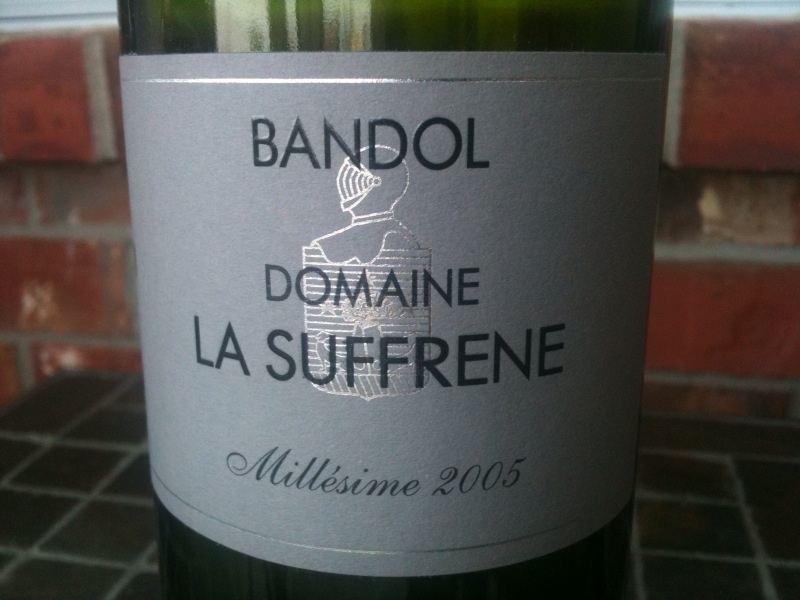
Domaine La Suffrène 2005 Bandol

Producer: Domaine La Suffrène

Grapes: 55% Mourvèdre, 20% Grenache, 15% Cinsault, 10% old-vine Carignan

Appellation: Bandol (AOC, France)

Vineyards: “sandy-silt-laden, calcareous and clay” soils

Vintage: 2005

Winemaking: 18 months in oak (% new unknown)

Alcohol: I failed to note it.

Price: I paid around $30 at Austin Wine Merchant

Tasting notes: On the nose, there is a spicy, black pepper layer on top of the red fruit (berries and maybe some plum). A definite whiff of horse stable on the nose, but a nice clean horse stable, like the ones with the clydesdales at Busch Gardens and SeaWorld. On the palate, it has good dark fruit, but it’s strength for me is in its leathery, savory, earthy qualities. A wine for contemplation, not quaffing.

Overall impression: A real winner for me. B+

Free association: I picture Dumbledore drinking this in his office after a long day battling office politics at Hogwarts.